

How to capture emotional episodes in everyday life using ESM / EMA burst designs.
TL;DR
Traditional experience sampling (ESM) / ecological momentary assessment (EMA) often measures people at fixed or random moments during the day. This works well for general fluctuations in mood, but it can miss short emotional episodes. Episode-contingent burst designs offer a solution: when an emotional episode is detected, the study sends several follow-up questions close together. A new study shows that these designs can capture high intensity emotions, but researchers need to balance detection, burden, and compliance.
Imagine you want to study how people recover after feeling rejected, stressed, excited, or proud.
Your experience sampling (ESM) / ecological momentary assessment (EMA) schedule is designed to send eight surveys per day. A participant has an intense argument at 10:40, feels very upset for 80 minutes, and starts recovering by noon. Your next beep arrives at 13:45.
What did you capture? Probably not the episode itself.
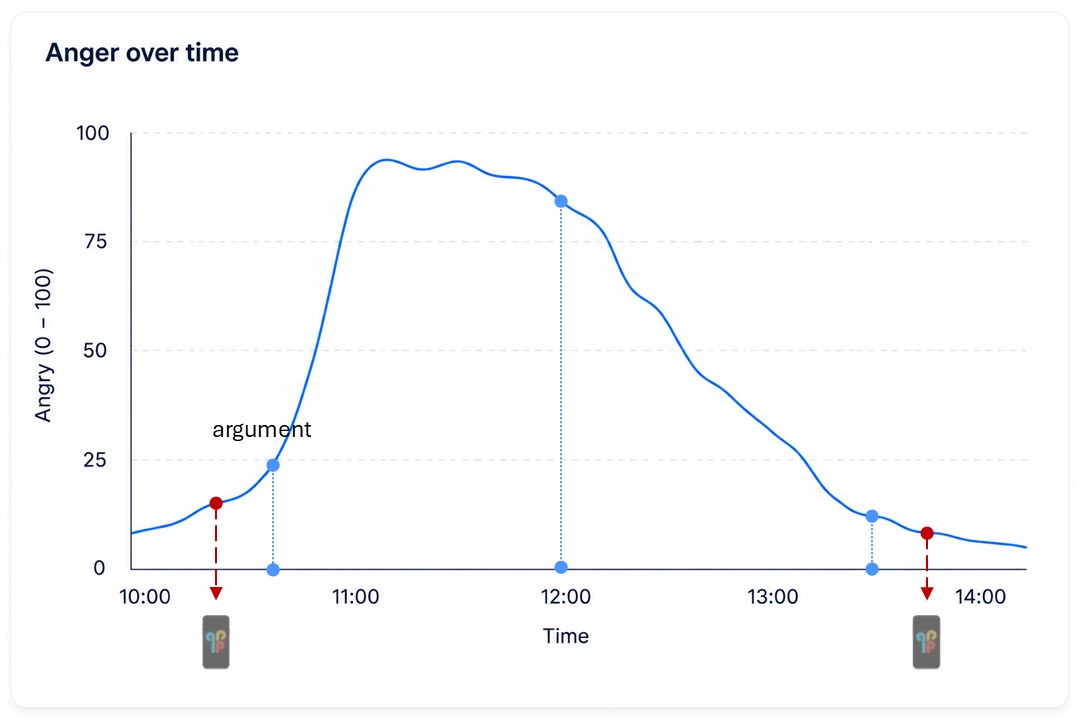
Time-contingent ESM / EMA may completely miss the relevant moments in people's lives.
This is a common challenge in ESM / EMA research. Time-contingent designs are excellent for measuring emotional life across days or weeks. They help researchers estimate global trends in mood, variability, and associations between experiences in daily life.
But emotional episodes often unfold quickly. Recovery, regulation, rumination, or savoring may happen within minutes or hours. When beeps are several hours apart, researchers may miss the emotional peak and the recovery process that follows.
Capturing emotional episodes through burst designs
An episode-contingent burst design is an ESM / EMA design that zooms in when something important happens.
Instead of only asking questions at regular moments, the study fires a short “burst” of repeated assessments after an emotional episode is detected. For example, participants might receive several follow-up beeps every 10 minutes after something emotionally meaningful happened.
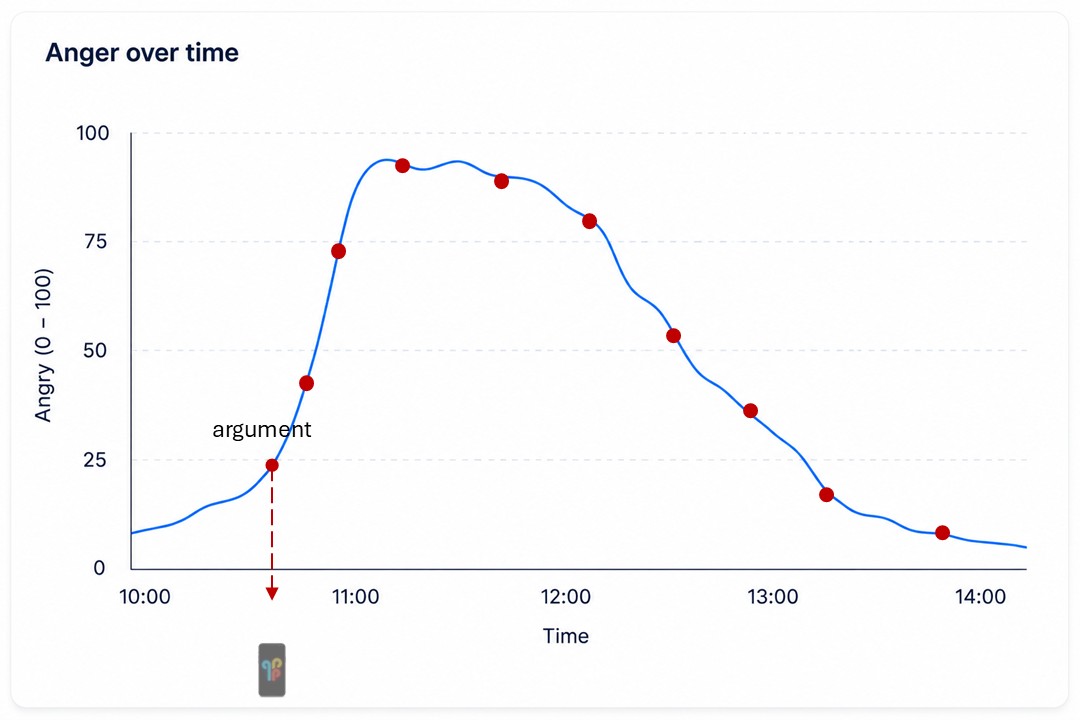
Episode-contingent burst designs map meaningful emotional episodes.
Think of it like switching from a wide-angle camera to a detailed zoom. The regular ESM / EMA schedule gives you the broader day. The burst gives you the fine-grained emotional sequence.
The study at a glance
In a recent paper, Yuanyuan Ji and colleagues explored the effectiveness and feasibility of burst designs to capture emotional episodes. Bundling data from three m-Path studies (n = 185), they compared two ways to trigger these bursts, alongside traditional time-based sampling schemes:
1. Threshold-based burst designs
A burst starts when a participant’s emotion rating at a regular (time-based) measurement crosses a predefined threshold (e.g., >50 on a 0-100 slider scale).
This has a clear advantage: participants do not need to decide when an episode counts. The design uses thresholds. This makes the procedure more standardized.
But signal-based burst designs still depend on regular notifications. If an emotional episode happens between two beeps, the system may never detect it.
2. Event-based burst designs
A burst starts when participants log an emotionally meaningful event themselves.
This sampling scheme can capture episodes that would happen between scheduled measurements. It also gives participants more control.
However, it introduces another problem: participants may forget, hesitate, or choose not to report an episode. No logs, no data. When participants do not press the button in their ESM / EMA app, the episode remains invisible, no matter how important it was.
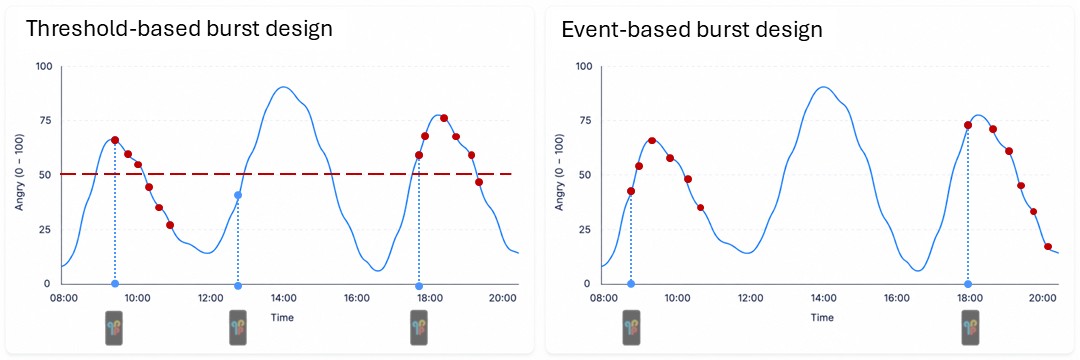
Threshold-based versus event-based burst design in ESM / EMA.
What they found
1. Both burst designs capture more intense emotions.
Both threshold- and event-based burst designs capture emotional episodes with higher intensity than regular time-contingent ESM / EMA measurements.
This finding matters. It shows that burst designs are doing what they are supposed to do: they bring researchers closer to emotionally meaningful moments (both positive and negative).
2. Threshold-based burst designs capture more episodes...
Threshold-based bursts detect more episodes than event-based bursts. The difference was clear: 1.60 episodes per day for threshold-based bursts versus 0.39 episodes per day when participants had to log episodes themselves.
This makes sense. Threshold-based burst designs actively check for episodes during regular prompts. Event-based bursts depend on participants noticing and reporting episodes themselves.
3. ..., but threshold-based burst designs are also more burdensome.
Threshold-based bursts generally led to higher burden and lower compliance than event-based bursts, especially for follow-up prompts.
Burden also increased over time in threshold-based burst designs and time-contingent designs, but not clearly in event-based bursts. That suggests that participant control helps keep the design manageable.
Still, event-based bursts have their own burden. Participants must actively monitor their emotional life and remember to report episodes. Several interviewees mentioned that this required effort.
4. Positive and negative episodes differed by design.
Finally, the two designs differed in the type of episodes they captured.
In threshold-based burst designs, negative episodes were triggered more often than positive episodes. In event-based burst designs, positive episodes were reported more often than negative episodes.
This is important for researchers. A design may shape not only how many episodes you capture, but also which emotional episodes enter your dataset.
Do participants avoid reporting negative events because they feel too confronting? Where the thresholds for negative emotions too sensitive? These are not just compliance questions. They affect the interpretation of emotion dynamics.
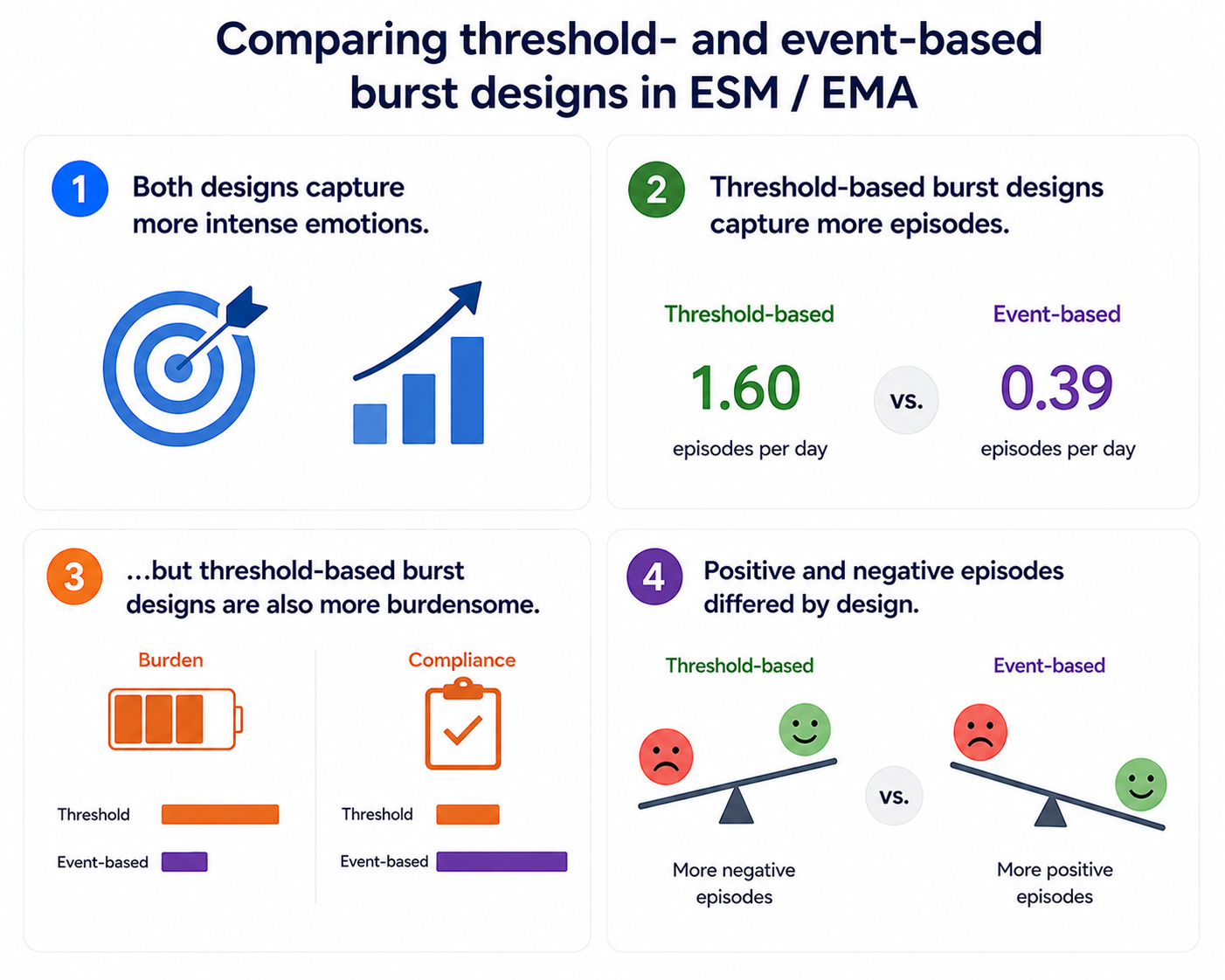
Differences in detection, burden and compliance for threshold- and event-based bursts.
How to choose the right burst design for your ESM / EMA study
The study shows that there is no single best episode-contingent burst design. The right choice depends on your research question.
Use threshold-based burst designs when:
- You want a more standardized detection rule.
- You need many detected episodes.
- You can define meaningful emotion thresholds.
- You accept that episodes between regular beeps may be missed.
- You try to reduce burden through other design choices.
Use event-based burst designs when:
- You want participants to report events as they happen.
- You study clearly identifiable events, such as conflicts, cravings, or panic episodes.
- You want to reduce notification burden.
- You can train participants well on what counts as an event.
A hybrid design may also be useful. For example, researchers could combine regular ESM / EMA notifications, automatic threshold triggers, and participant-initiated event buttons. That would increase complexity, but it may improve coverage.
Practical tips for implementing a burst design in ESM / EMA
If you plan to use an episode-contingent burst design, consider these tips before launching your ESM / EMA study:
- Define the episode clearly. Participants need to know what counts as an emotional episode. Give concrete examples, borderline cases, and non-examples.
- Pilot your thresholds. In threshold-based burst designs, your data depend heavily on the threshold you set. A threshold that is too sensitive may trigger too many bursts. A threshold that is too strict may miss relevant episodes.
- Support active logging. Event-based burst designs depend on participants noticing and reporting episodes themselves. Reminders, clear instructions, and practice trials can help.
- Keep burst surveys short. Follow-up beeps arrive close together, sometimes within minutes. Long questionnaires can quickly become annoying.
- Monitor burden and compliance over time. Burden may increase and compliance may decrease as the study progresses. Combine quantitative indicators, such as response rates, with qualitative feedback about why participants missed beeps.
- Plan for variable data entries. Burst data depend on when episodes happen, whether they are detected, and whether participants respond. Think in advance about how many episodes or follow-up data points you need, rather than only how many days the study should last.
- Think carefully about compensation. Compensation can shape participant motivation, especially in event-based burst designs. You may want to reward both study participation and adequate follow-up compliance, without encouraging participants to over-report episodes.
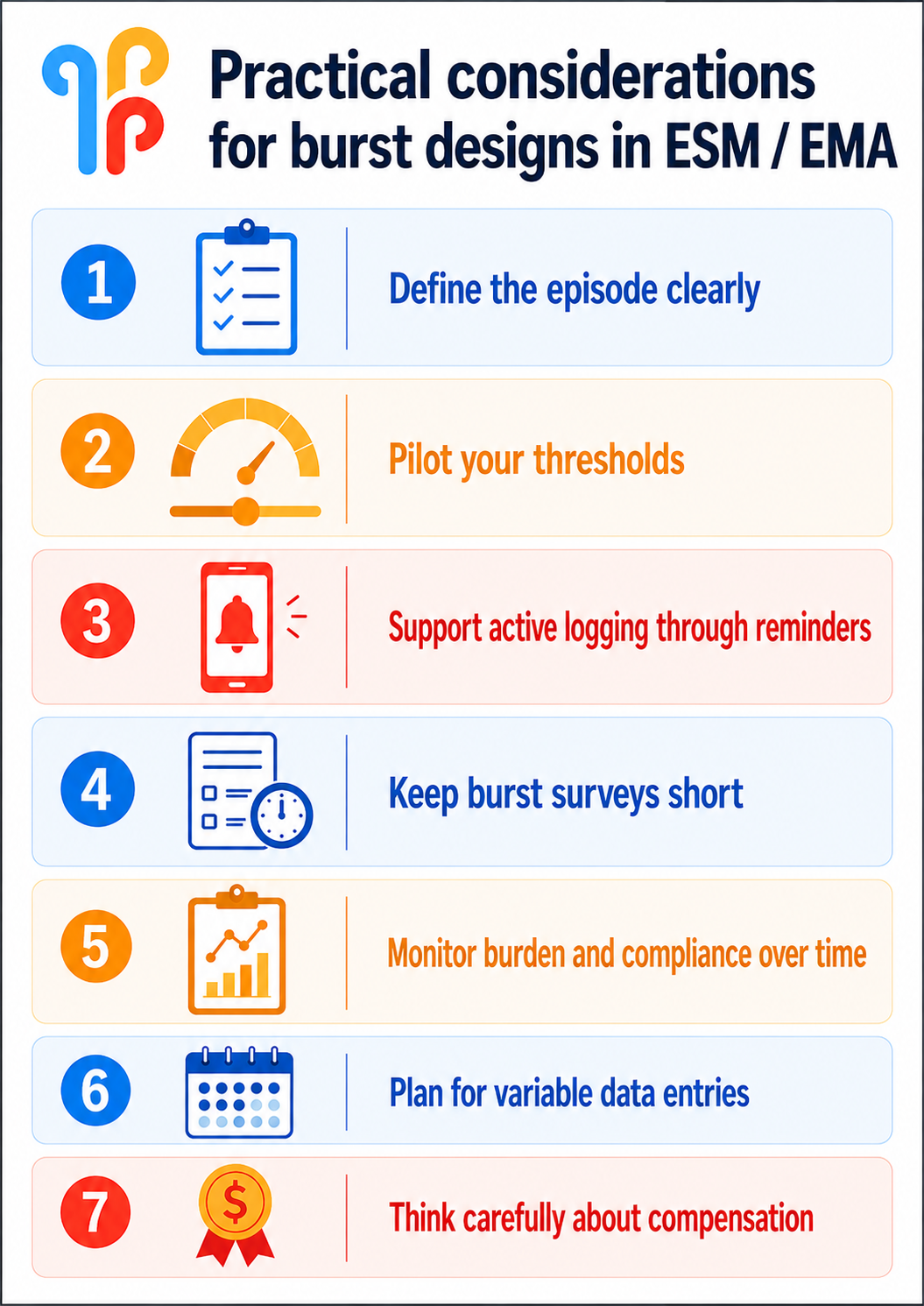
Recommendations for episode-contingent burst designs.
Final take-away
Episode-contingent burst designs help ESM / EMA researchers study emotional episodes at the timescale where they actually unfold. They are especially useful when researchers care about emotional peaks, recovery, regulation, or short-lived clinical events.
But the design choice matters. Threshold-based burst designs captures more episodes, while event-based may reduce burden and improve follow-up compliance. The best design depends on what you want to capture, how easily participants can recognize it, and how much burden your protocol can reasonably impose.
Want to design an ESM / EMA study that captures emotional episodes in daily life? Start by asking one question: Should the app detect the episode, should the participant report it, or do you need both?
Check out our dedicated manual page on follow-up items to learn how to implement a burst design in your ESM / EMA study.
👉 Explore the full paper here: Psychological Assessment, 2025.

Dr. Egon Dejonckheere is an Assistant Professor at Tilburg University, affiliated with KU Leuven, specializing in ambulatory assessment and intensive longitudinal research.
His work combines methodological innovation to improve these methods with applications in mental health and emotion dynamics, and includes dozens of smartphone-based studies in daily life.