

How to make ESM / EMA accessible for vulnerable populations.
TL;DR
Experience sampling methodology (ESM) / ecological momentary assessment (EMA) is often seen as demanding: long studies, repeated self-reports and frequent interruptions of people’s daily routines. But recent m-Path studies show that ESM / EMA can work in populations where feasibility is not obvious, including patients with advanced cancer, children with intellectual disabilities, people with aphasia or dementia, and even people microdosing psilocybin. These studies show that the key is not to copy-paste a standard protocol, but to adapt the design to the population.
"Will this protocol not be too much for participants?"
If you have ever submitted an experience sampling (ESM) / ecological momentary assessment (EMA) study to an ethics committee, you have probably heard some version of this question.
And honestly, it is a fair concern.
ESM / EMA means multiple prompts per day, questions about sensitive experiences, and participation during moments that are not always convenient. For many populations, especially those considered vulnerable, an ethical review board may wonder whether the study is actually feasible, not too burdensome, or even appropriate.
But perhaps the question should not be: Can this population do ESM / EMA? 🤔
A better question is:
"What needs to change in the protocol so this population can do ESM / EMA safely, comfortably, and meaningfully?"
The five studies below all used m-Path in populations where ESM / EMA might initially raise feasibility concerns. Together, they show that ESM / EMA is not a rigid protocol to be copied across studies, but a flexible framework that can be adapted to the people taking part.
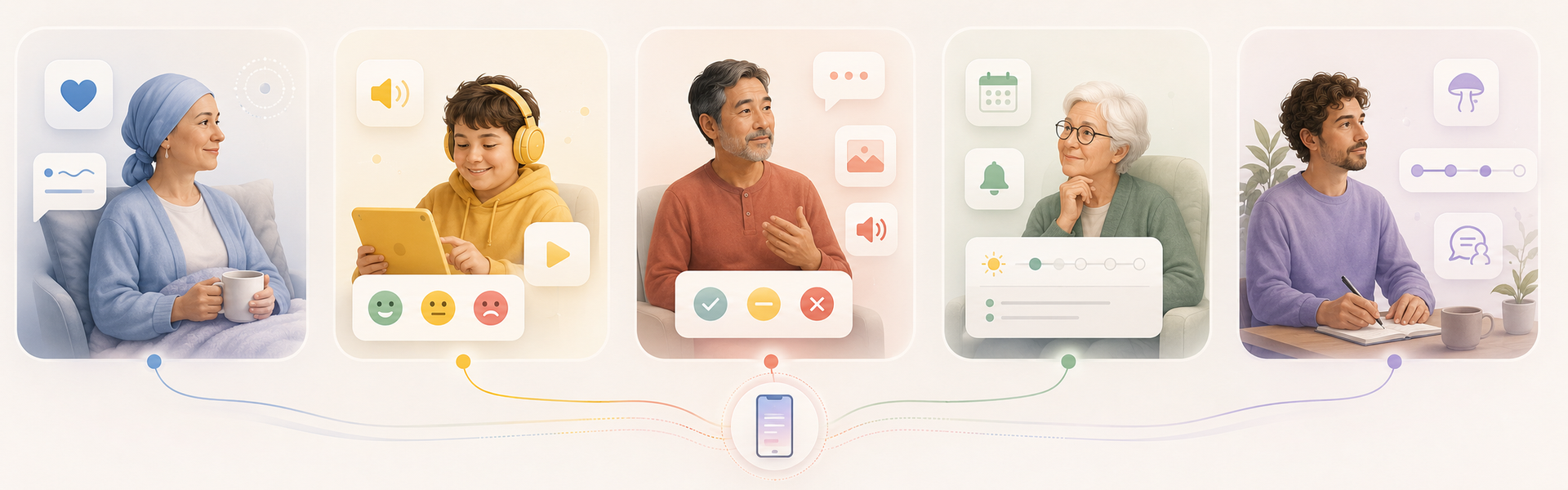
1. Patients with advanced cancer
In palliative care, ESM / EMA may sound demanding. People with advanced illness often deal with fatigue, pain, treatment burden, and emotional distress. That makes feasibility a real concern.
Yet, Geeraerts and colleagues (2024) showed that ESM / EMA in a palliative setting was possible trough careful preparation.
Trough multiple iterations, the team curated an ESM / EMA questionnaire for people with advanced cancer in close collaboration with the patients themselves and healthcare professionals.
The pilot protocol was intensive: participants were prompted 10 times per day for 6 consecutive days. Each participant received a smartphone with m-Path installed, received instructions and training, and was contacted by the researcher after the first study days to check whether everything was working properly.
Despite this intensive design, patients completed on average 80% of assessments. Participant feedback and observed difficulties helped the researchers refine the protocol, for example by changing item wording, extending the response window, improving training, and adding check-up calls to monitor distress as well as technical issues.
2. Children with intellectual disabilities
Children and adolescents with intellectual disabilities are often excluded from self-report research. Researchers may worry about reading skills, comprehension, abstract response scales, or whether participants can complete surveys independently.
Zurbriggen and colleagues (2026) took the opposite starting point. Instead of replacing self-report with proxy report (e.g., parents, teachers or caregivers), they asked how a daily diary design could be adapted so children and adolescents with intellectual disabilities could report their own emotional experiences.
Their design followed explicit criteria. The survey needed to support self-report, work for children with mild to moderate intellectual disabilities, require little or no reading, fit everyday situations, and remain manageable over time.
The m-Path platform made several accessibility adaptations possible. The survey used visual emoticons, audio recordings of questions, one question per screen, simple vocabulary, present-tense phrasing, and guidance throughout the survey.
The protocol also allowed for support roles. Participants answered the internal emotional experience items themselves. For external context items, such as activities or situations, an instructed adult could help when reading skills were limited.
The study included children and adolescents aged 5 to 15. All participants provided self-reports, with a median response rate of 84.2%, and no decline in response rate across the 8-week study period.
3. People with aphasia after stroke
Aphasia can make it difficult to understand, produce, or process language. That creates a major problem for survey research, where many standard questionnaires rely on complex wording and retrospective summaries.
Weseman and colleagues (2026) developed an aphasia-accessible ESM / EMA protocol to assess affective symptoms of depression in people with aphasia after stroke.
Their approach was deeply user-centered. The team worked with people with aphasia, care partners, and speech-language pathologists to select relevant depressive affect items. They also used cognitive interviews to check whether the final items, wording, visuals, and pictorial scale were understandable.
In m-Path, each item included multiple supports: on-screen text, an accompanying image, an audio recording, and a pictorial response scale.
Participants received 4 surveys per day for 14 days. On average, they completed 89.6% of EMA surveys. Compliance was not significantly associated with aphasia severity or cognitive performance, suggesting that even participants with more severe aphasia could meaningfully engage with the protocol.
Participants also rated the app positively. The average System Usability Scale score for the m-Path app was 85%, indicating high usability.
4. People with dementia
Dementia is another population where ESM / EMA may sound difficult at first. Researchers may worry about memory, comprehension, technology use, and whether participants can provide reliable self-reports in daily life.
Dewitte and colleagues (2025) challenged these assumptions with a high-intensity smartphone-based ESM / EMA study in people with dementia.
The protocol was co-designed with a lived-experience advisory panel, including people with dementia and caregivers. Their recommendations directly shaped the study. The team used Likert buttons instead of sliders, added a training video, extended (!) data collection from 7 to 10 days, and recruited a broad transdiagnostic sample.
Participants received 7 momentary notifications per day for 10 days. Each notification began with a short reminder explaining the study context, which helped re-orient participants.
The team also built in flexibility. They used practice sessions, accessible written instructions, video tutorials, follow-up video calls, tailored notification schedules, and personalized adjustments. In one case, notifications were synchronized with a partner’s phone so the partner could remind the participant to respond.
The study achieved 80% compliance, with no dropouts. Participants reported low burden, high motivation, and positive experiences with the app.
5. People microdosing psilocybin
Psilocybin microdosing is a context where ESM / EMA may be difficult for reasons beyond participant burden. The substance itself may influence attention, salience, cognition, sensory perception, and self-reflection.
Oblak and colleagues (2024) addressed this with a naturalistic mixed-methods study. Because of regulatory limitations, they could not standardize dose, timing, or regimen. Instead, they followed people already microdosing psilocybin on their own initiative and used m-Path to capture daily-life experiences.
The researchers first collected baseline data, then followed participants across microdosing days and off-days. This helped them compare microdosing experiences against each participant’s usual interaction patterns, rather than treating every unusual report as a direct drug effect.
They also combined momentary reports with repeated phenomenological interviews and debriefings. These helped clarify what participants meant in short in-the-moment responses and how they later made sense of their experiences.
This study highlights that when the phenomenon may affect ESM / EMA responding itself, momentary data should not stand alone. Baseline sampling, on-days, off-days, and follow-up interviews can help researchers interpret both momentary reports and later sensemaking.
Why this matters for your research
These studies differ widely, but their design logic and study considerations are strikingly similar.
Below, we pull out five common threads that explain why ESM / EMA worked in such different populations.
1. Start with the population, not your assumptions
These protocols did not begin with “Here is a standard ESM / EMA design.” They began with the people who would actually take part in the study.
Importantly, the researchers did not start from the assumption that “This will probably not be possible.” Instead, they treated feasibility as an empirical and design question: what would need to change for this population to participate meaningfully?
That meant involving patients, healthcare professionals, care partners, speech-language pathologists, parents, teachers, trainers, or lived-experience panels. This stakeholder input helped shape the protocol before and during the study, from item selection to training and support.
2. Reduce unnecessary burden
Burden is not only about the number of prompts.
It is also about item wording, response format, reading demands, notification timing, device handling, training, and whether participants understand why the phone is beeping.
3. Use accessibility as a measurement tool
Images, audio, emoticons, clickable buttons, simplified scales, and one-question-per-screen layouts are not cosmetic features.
They shape whether participants can understand the question and give a meaningful answer.
4. Build in support
Training sessions, practice prompts, check-up calls, caregiver involvement, and technical troubleshooting can make the difference between a protocol that looks feasible on paper and one that works in daily life.
5. Treat feasibility as an empirical question
These studies did not assume feasibility. They tested it.
They measured compliance, completion times, burden, usability, dropout, and participant feedback. Then they adjusted the protocol.
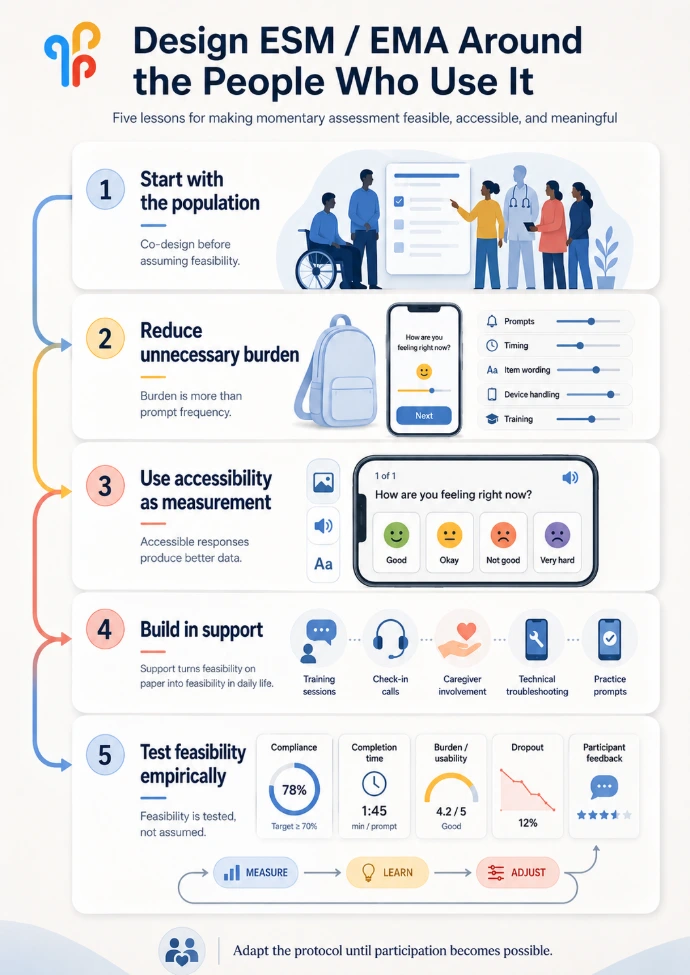
How to tailor ESM / EMA to your target population to improve feasibility.
A useful message for your ethical review board
These five studies do not prove that every ESM / EMA protocol is feasible for every population.
They show something more useful: feasibility can often be designed.
With stakeholder involvement, accessible interfaces, flexible timing, participant support, and real-time burden monitoring, ESM / EMA can be adapted to populations that might otherwise be excluded from real-time research.
That matters scientifically and ethically.
Because excluding people from ESM / EMA research can also mean excluding their daily experiences from the evidence base.
Preparing an ESM / EMA study for ethical review? m-Path gives you the flexibility to design participant-centered protocols, from accessible response formats and multimedia support to flexible schedules and real-time compliance monitoring. Use m-Path to make feasibility part of your study design, not just an assumption.

Dr. Egon Dejonckheere is an Assistant Professor at Tilburg University, affiliated with KU Leuven, specializing in ambulatory assessment and intensive longitudinal research.
His work combines methodological innovation to improve these methods with applications in mental health and emotion dynamics, and includes dozens of smartphone-based studies in daily life.